Published on May 07, 2026 (Updated on May 08, 2026)

You are moving and wondering what to do with your home charging station. When you own an electric vehicle, this question quickly becomes a strategic one.

Moving already requires a lot of organization. Your home charging setup, therefore, deserves careful consideration.


Should you move your charging station or leave it behind?

Before dismantling anything, take a moment to evaluate your options. Moving a charging station can make sense, but it is not always the best option.

Ask yourself three simple questions:

  • Are you satisfied with your current equipment?

  • Can your new home support a similar installation?

  • Does the added value for the buyer compensate for leaving it behind?

More and more homebuyers already own an electric vehicle. An existing charging station can therefore become a real selling point when you list your property.

If you leave the equipment behind, you may simplify the real estate transaction.
If you choose to relocate your charging station, you avoid having to purchase a new one.

The best decision mainly depends on costs and the electrical configuration.
Costs to consider when moving a charging station

Icon representing an electric car charging station

Many homeowners underestimate the costs involved in removing and reinstalling a charging station.
Installing a residential charging station is never as simple as a plug-and-play connection.

If you decide to move your equipment, you will need to:

  • Hire a certified electrician

  • Disconnect the charging station from the electrical panel

  • Adapt the wiring at the new location

  • Install the station according to local electrical standards

In Canada and the United States, costs vary widely by region and project complexity. The distance between the electrical panel and the garage often influences the final budget.

The real comparison is not the installation itself. You will need to install a charging station in your new home anyway.

The key question becomes:
Is it more cost-effective to transfer your existing equipment or invest in a newer model?

If your station is several years old, investing in a new installation may improve performance and compatibility.

We recommend requesting two quotes:

  • One for relocating your existing charging station

  • Another for a complete installation of a new system

Comparing these estimates will help you make an informed decision.

Steps to move your charging station safely

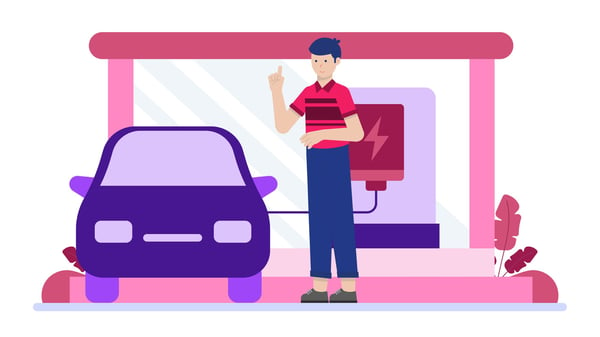
Illustration of a driver charging their electric car at a residential charging station

If you decide to move your equipment, follow a structured approach. This protects both your investment and your safety.

1. Have the current installation evaluated

Before anything else, ask an electrician to inspect your existing setup. They will check the wiring condition and the dedicated circuit breaker. This step prevents you from transporting an outdated system.

2. Plan the removal

Never attempt to remove a charging station yourself. A 240-volt circuit can cause serious damage or injury. A licensed electrician will safely cut power and remove the equipment in accordance with code.

3. Protect the charger during transport

Carefully pack your equipment to avoid damage. Keep screws and wall mounts in a labelled bag. A well-protected charging station maintains its longevity.

4. Prepare the new home

Before moving in, have the electrical panel inspected. Your new home must be able to support EV charging without overloading the system. If the panel lacks capacity, it may need to be upgraded. In this case, the installation project becomes more complex.

5. Install and test the equipment

Once installed at the new home, the electrician will reconnect the charging station and verify that it works properly with your electric vehicle. A full test ensures stable and safe charging.

Move your charger or buy a new one?

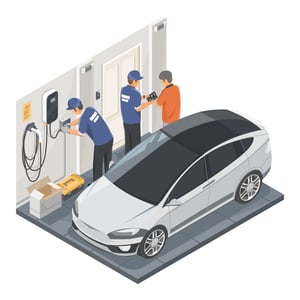
Illustration of technicians installing an electric car charging station at home

Recent models offer smarter energy management and improved compatibility with newer electric vehicles.
You can also explore our range of residential charging stations to evaluate available options and compare performance.

In some cases, leaving your charger for the buyer can increase the appeal of your property.You can then install a more advanced model at your new home that better fits your current needs.

On the other hand, if your existing installation is recent, reliable, and still under warranty, moving it might be the most logical choice.

We recommend evaluating:

  • The age of the equipment

  • The remaining warranty

  • Available incentives or rebates

In Canada, several financial assistance programs still support home charging station installation. It is always worth checking whether you qualify for new rebates at your new address.

Electrical standards and requirements in Canada

Each Canadian province and US state applies its own electrical regulations. Homeowners cannot improvise electrical installations. In Québec, Ontario, or British Columbia, a certified electrician must perform the work. In the United States, local electrical codes also regulate installation.

Plan these steps several weeks in advance to avoid delays.

Special case condos and multi-unit buildings

Moving a charging station to a condo requires a specific evaluation. Electrical infrastructure in these buildings is often shared.

In this context, installation may require the following:

  • An energy capacity study

  • The addition of an individual meter

  • Approval from the building association or board

These steps can delay your ability to charge at home, so it is best to start the process early.

Common mistakes to avoid

Even experienced homeowners sometimes make mistakes. These are the most common ones we see.

  • Underestimating installation costs at the new home

  • Ignoring electrical code compliance

  • Transporting equipment without proper protection

  • Attempting installation without professional certification

Safety should always come first.

Plan your move carefully

Changing addresses does not mean starting from scratch. Your electric vehicle deserves a stable and reliable charging solution.

Whether you decide to move your charging station or install a new one, take the time to evaluate your needs.

Prepare your transition, optimize your installation, and continue driving your electric vehicle with confidence.

Looking for public charging stations near your new home?
Download the ChargeHub app to easily locate charging stations across Canada.

Prepare your transition, optimize your installation, and continue driving your electric vehicle with confidence.

FAQ moving a residential charging station

Can I remove my charging station myself?

No. A charging station connects to a high-voltage circuit. A certified electrician is required to handle the work safely.

Is moving my charging station cost-effective?

It depends on the age of the equipment and local installation costs. A comparative quote is the best way to get a clear answer.

Can I install my charging station in any garage?

Not always.

The electrical panel must have enough capacity to support home charging. An inspection will confirm whether your new home can support the installation without a major upgrade.

Do I need a permit to install a charging station?

In several Canadian provinces and some US states, an electrical permit may be required. A certified electrician understands local requirements and ensures your installation complies with current regulations.