Published on April 08, 2026 (Updated on April 08, 2026)

The EV charging experience remains one of the most discussed friction points in electric vehicle adoption and one of the least consistently measured. Drivers notice when a charging session fails. Far fewer report when it works seamlessly. Over time, this imbalance has shaped industry perception, often amplifying negative experiences while overlooking networks that consistently deliver reliable performance.

But the real issue isn’t just perception, it’s measurement. Without a consistent, large-scale view of what drivers actually experience, it becomes difficult to distinguish isolated issues from systemic performance, or to identify which networks are truly delivering reliable charging.


What Real User Data Reveals About EV Charging Networks

To address this gap, ChargeHub leveraged its scale, over one million annual users and access to more than 160,000 charging ports across North America, to build a clearer picture of real-world charging performance.

This led to the development of the EV Charging Experience Barometer, a proprietary methodology introduced in 2023 that classifies each charging session into a four-tier framework, ranging from fully successful to failed attempts.
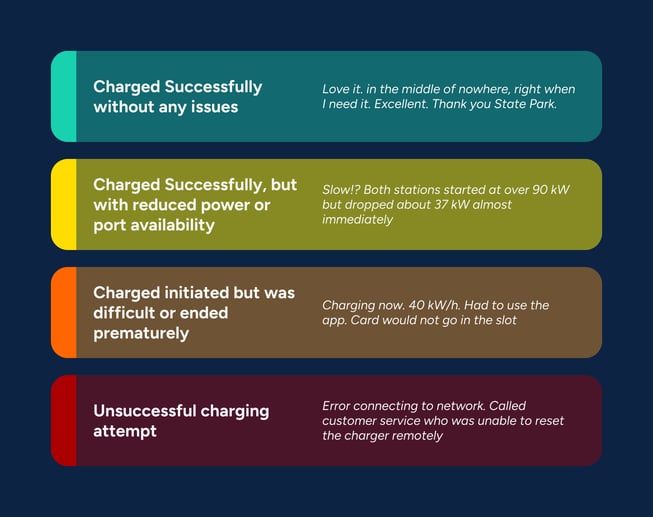

EV charging success rate


But the Barometer goes further than a simple success/failure split. Each session is also analyzed for qualitative signals, driver-reported context, error patterns, and contextual factors that explain why a session succeeded or failed. This makes it possible to distinguish between a network with occasional technical issues and one with systemic reliability problems, and to identify the operational practices that consistently lead to better outcomes for drivers.

This framework does not rely on operator-reported data or periodic surveys. It captures what EV drivers actually experience, session after session, across every major network. 62% of sessions analyzed in 2024 were classified as successfully charged without issues.

Over time, that accumulation of real-world data becomes something the industry can actually use, not just to understand where public charging falls short, but to identify where it consistently delivers.


Turning Data Into Industry Recognition

Charging networks invest significantly in infrastructure, maintenance, and driver experience. But that investment rarely earns public visibility. Performance data circulates within organizations and regulatory bodies; few mechanisms exist to surface it openly.

Governments across North America have committed to ambitious EV adoption targets, and network reliability is increasingly central to those conversations. Infrastructure funding, OEM partnerships, and fleet procurement decisions are all shaped, in part, by confidence in the quality of the charging experience networks can deliver.

As Simon Ouellette, CEO and Co-Founder of ChargeHub, puts it:

"The industry has no shortage of data. What it lacks is a mechanism to turn that data into meaningful recognition."

Introducing a Data-Driven Standard for Recognition

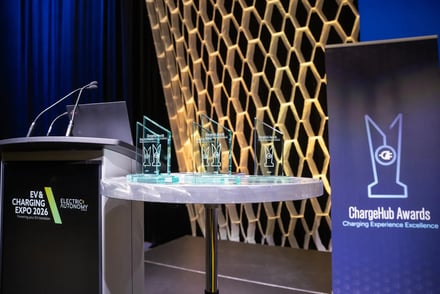
The ChargeHub Awards: Charging Experience Excellence ceremony will take place on April 9, 2026, at the Enercare Centre in Toronto, during the EV & Charging Expo Happy Hour, in partnership with Electric Autonomy.

Bringing together charging network operators, OEMs, government representatives, and industry stakeholders, the event marks a key moment for the industry, where recognition is no longer based on perception, but on data.