Published on September 29, 2025 (Updated on September 29, 2025)

This introductory document presents the basic concepts behind EV roaming. After reading it, you will get a better understanding of the following topics: 


What is EV Roaming?

EV Roaming, also known as eRoaming, is behind the compatibility of public charging systems, enabling drivers to effortlessly connect and charge their vehicles across a variety of charging networks without the hassle of managing multiple subscriptions, apps, or cards. Access to the most seamless integration to the public charging infrastructure is of critical importance to offer an easy charging and payment experience to EV drivers.

Who are EV Roaming's main stakeholders?

Before presenting the concept of EV Roaming in more detail, it is essential to define the key stakeholders behind a roaming charging event. 

1) E-Mobility Service Provider (eMSP)

An EMSP offers EV drivers access to charging services (find, activate, pay). Examples of EMSPs include charging companies with apps/RFID cards, as well as automotive OEMs and fleet managers. Increasingly, eMSPs are offering Plug & Charge capabilities.

2) Charge Point Operator (CPO)

A CPO is responsible for the installation, operation, and maintenance of EV charging stations. They own or manage the physical infrastructure and ensure the stations are functioning correctly, accessible, and delivering electricity efficiently. It is not uncommon for a CPO to also be an eMSP in North America.

A third stakeholder is also essential to define, as it is the interface that enables the management of charging stations.

3) CPO Backend or CSMS (also known as Charging Station Management System)

A CPO Backend is the software layer through which a CPO manages their infrastructure (Pricing, Monitoring, Station updates, Data collection, Diagnostics, User and access control). A CPO Backend can be a CPO’s own or licensed from a third-party.

A fourth stakeholder can act as a centralized digital and financial exchange platform to enable transactions between eMSPs and CPOs. 

4) Roaming Hub

A Roaming Hub provides a “centralized market place” to simplify transactions between eMSPs and CPOs. Their integration avoids the need for individual entities to develop peer-to-peer roaming agreements and connections. They can also act as a clearing house to provide financial settlement services that facilitate payment reconciliations between participants.

As explained below, a roaming hub is not mandatory to enable roaming between eMSPs and CPOs; however, it becomes essential to provide EV roaming at scale.

What are the four pillars of EV Roaming?

As explained previously, EV Roaming is the concept of connecting eMobility Service Providers (eMSPs) and Charge Point Operators (CPOs) to allow drivers to find, activate, and pay for charging at public charging infrastructure using their preferred method. This connection relies on four pillars:

image6  Technical image2  Commercial image5  Legal image3  Financial
Roaming enables an EMSP to receive charge point information and send session commands to the CPO Backend via APIs, typically in the OCPI format. Defines commercial terms between the EMSP, the CPO and often, a roaming Hub (pricing, revenue commissions, invoicing and settlement). Defines contractual obligations between parties (SLAs, pricing and billing terms, liability and dispute resolution, data sharing and privacy, authorization and access rules). An EMSP must pay the CPO for the sessions conducted by its users on the CPO’s stations, which is facilitated through a financial reconciliation. It can be facilitated through a roaming hub.

What are the different ways to provide EV Roaming?

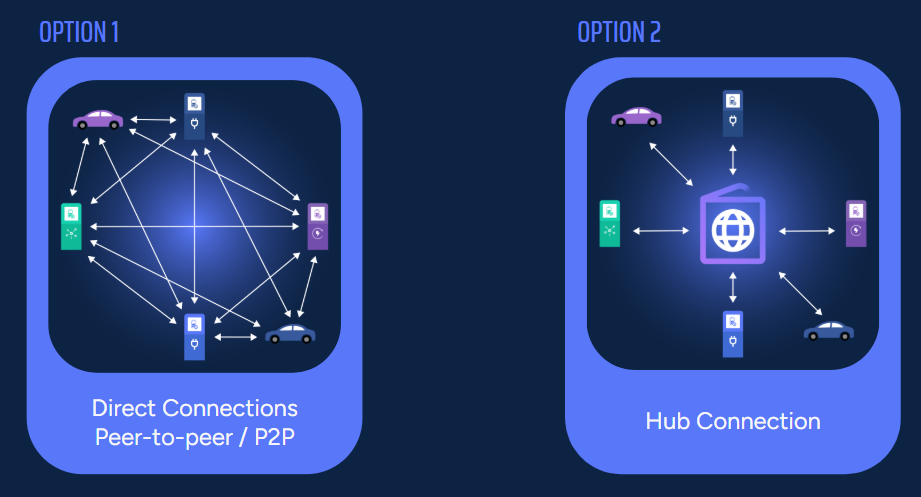
There are two primary methods for the industry to offer EV roaming services: a peer-to-peer approach and a roaming hub.

Peer-to-Peer approach

In a peer-to-peer (P2P) approach, two networks establish a direct agreement to enable roaming between them. Each agreement typically requires technical integration, as well as legal and business negotiations, and periodic financial reconciliations. Managing multiple bilateral agreements can quickly create administrative and technical overhead, which can be taxing for teams. While this model offers flexibility and control, it is exponentially complex to scale, especially as the number of roaming partners grows. 

Roaming Hub approach

A roaming hub serves as a centralized connection point that links multiple eMSPs and CPOs together under a single, but flexible integration and standardized commercial agreement. Instead of building and maintaining numerous peer-to-peer connections, participants only need to connect once to the roaming hub to access a broad ecosystem of partners. This model significantly reduces complexity, streamlines time-to-market for new roaming opportunities, and simplifies eMSPs and CPOs operations. As a result, roaming hubs such as ChargeHub’s Passport Hub are an efficient and scalable way to support seamless EV charging experiences across different networks.

Capture d’écran 2025-09-24 141256

Why the Market Favours a Hub Approach

As EV roaming matures, the market is increasingly favouring a hub-based approach for its scalability, efficiency, and simplicity. With peer-to-peer agreements, every new partner requires duplicating effort across technical integration, contracts, settlement, and ongoing maintenance—slowing growth and adding unnecessary complexity. In contrast, a hub like ChargeHub’s Passport Hub provides a single connection point to access a vast network of eMSPs and CPOs, backed by a single integration, a single agreement, and a single financial reconciliation process. 

This approach also streamlines support for multiple activation and payment methods, including app activation, RFID/NFC, Plug & Charge, and credit card terminals, ensuring a seamless charging experience. The result is faster expansion, easier operations, and improved scalability. ChargeHub’s Passport Hub can also support a hybrid model, offering a standardized technical foundation through the hub while still allowing flexibility for unique commercial arrangements.