Published on May 14, 2026 (Updated on May 14, 2026)

Not all public chargers are automatically compatible with every electric vehicle (EV). Contrary to what you might expect, this compatibility depends less on the network itself than on the connector type, the charging power your vehicle can accept, and how you access the charger. Once you understand these three things, it becomes much easier to locate where to plug in and plan your charging stops.


What is a public charging network?

A charging network is a group of chargers operated by the same company. In practice, this affects which app you need to use, how you pay, the rates you're charged, and what features are available. However, it doesn't mean that each network necessarily uses a different connector. Whether a charger is compatible with your vehicle depends mainly on the type of plug available at the station, the power it can deliver, and the access requirements.

The good news: most public chargers are compatible with the majority of EVs

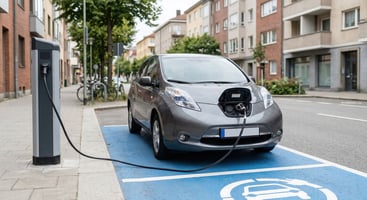
Electric vehicle plugged into a charging station in a dedicated parking space

When you're just starting out, it's easy to assume that each network works only with its own plugs, as if every brand had its own closed system. In reality, the North American market has largely standardized around a few well-established formats.

For Level 2 charging, the most common connector is the J1772. It's used on a large share of public AC charging stations in North America, and it's also the connector found on most electric vehicles, with the exception of Teslas.

For fast charging, you need to pay a bit more attention. Depending on your vehicle, you may need a CCS port, an NACS port, or, less commonly, a CHAdeMO port. That said, these standards are now well established, which makes charging considerably simpler than it was a few years ago.

How to know whether a charger is compatible with your vehicle

Before plugging in, get into the habit of checking these three things.

1. The connector type

This is the starting point. If the charger's connector doesn't match your vehicle's port, the session won't start unless you have a compatible adapter.

In Canada and the United States, you'll most commonly encounter these formats:

  • J1772 for Level 2 charging

  • CCS for a large portion of public fast charging

  • NACS on Tesla vehicles and a growing number of fast-charging stations

  • CHAdeMO on some older vehicles, mainly certain Japanese models

2. Your vehicle's maximum accepted power

Even if a charger advertises a very high power output, your vehicle will only draw what it can handle. This matters when estimating how long your stop will take.

For example, plugging into a very powerful charger won't save you any time if your vehicle's charging speed is capped well below that level. The right habit is to check your model's maximum charging capacity, especially before long trips.

3. How do you access the public charger

A charger may be physically compatible with your vehicle but still require a specific app, a payment card, a network account, or a mobile activation.

This is often where new EV drivers get caught off guard. The cable fits, but the right app or activation method is missing. This is exactly why many EV drivers prefer using a solution that centralizes multiple networks in one place.

Which connectors are found in North America?

J1772 for Level 2 charging

The J1772 is the most widely used standard for Level 2 charging in North America. You'll find it in many parking lots, shopping centres, hotels, residential buildings, workplaces, and municipal spaces.

In practice, if you drive a non-Tesla EV, you'll be able to use most public Level 2 chargers without any issues. Tesla vehicles can also use this type of charger with the appropriate adapter. For fast charging, however, compatibility depends more on your vehicle's port and the connector available at the station.

CCS for fast charging

CCS is one of the main fast-charging standards in North America. It allows the same vehicle port to be used for both AC charging and DC fast charging. It builds on the J1772 design by adding two extra pins for fast charging.

Many vehicles use this standard for fast charging. If your vehicle has a CCS port, you'll have access to most public fast chargers.

NACS and the Tesla network

NACS is taking up an increasing share of the North American market. Long used exclusively by Tesla, this connector is now being adopted or gradually integrated by several other automakers. At the same time, part of the Supercharger network is also opening up to non-Tesla vehicles, depending on the station and the vehicle's compatibility or adapter.

In practice, some Superchargers are now accessible to non-Tesla vehicles, but not all of them. Depending on the location, you may need a vehicle that is already NACS-compatible or a suitable DC adapter. It's essential to check station compatibility via the app before heading out.

CHAdeMO: still around, but less common

CHAdeMO was long used on certain vehicles, particularly older models. It's still present at some fast-charging stations, but its footprint is shrinking compared to CCS and NACS.

If you drive a vehicle with a CHAdeMO port, be sure to verify your stops in advance before a long trip.

A more powerful charger won't damage your battery

This is a common concern, but using a charger that's more powerful than your vehicle requires won't harm your battery. The charger may be capable of delivering high power, but your vehicle acts as the gatekeeper and will only draw what it can safely absorb. If your model is limited to 50 kW, it won't receive more than that, even when plugged into a more powerful station.

Being compatible doesn't always mean you can charge right away

This is probably the most useful thing to keep in mind.

Compatibility isn't just about the port type. You might arrive at a charger that's a perfect physical match for your vehicle, only to run into another obstacle:

  • the network's app isn't installed

  • payment isn't set up

  • the charger is already occupied

  • the charger is temporarily out of service

  • the right connector is present, but not available at the specific charger you chose

That's why knowing which connector your car uses isn't enough on its own. You also need to be able to quickly check real-time availability, the network requirements, the activation method, and the power output.

Why planning with ChargeHub can make your life easier

When planning an EV trip, the goal isn't just to find a charger; it's to find one that's compatible, available, and suited to your vehicle.

That's where an app like ChargeHub becomes useful. It lets you find chargers based on connector type, charging speed, and available networks, helping you avoid unpleasant surprises along the way.

Rather than scrambling to verify everything at the last minute, you can filter options based on your vehicle and plan your stops with confidence.

Use ChargeHub to find compatible chargers, check available connectors, and plan your stops with confidence.


3 simple habits before you head out

Identify your vehicle's connector

You may not know the exact name, but it's helpful to know which type of plug your vehicle uses for Level 2 and fast charging. You'll find this information in the owner's manual, on the manufacturer's spec sheet, or simply by looking at the labels inside the charging port.

Check your model's maximum charging speed

Not all electric vehicles charge at the same speed, even when plugged into the same charger. Knowing your vehicle's maximum accepted power will help you choose the most efficient stops and avoid paying for ultra-fast charging you can’t use.

Plan your trip before your battery runs low

Waiting until the battery is nearly empty to look for a charger is never the best approach. It's better to identify your options in advance, especially if you're travelling through an area with fewer charging stations.

FAQ

Are all Level 2 chargers compatible with all electric vehicles?

Not all of them, but the vast majority of public Level 2 chargers in North America use the J1772 connector. They're therefore compatible with most non-Tesla EVs, as well as Teslas equipped with the appropriate adapter.

Does a more powerful charger always charge my vehicle faster?

No. Your vehicle governs the charge and will only draw the power it can safely handle. A more powerful charger can be useful, but only up to your model's technical limit.

Can I use Tesla Superchargers with a non-Tesla vehicle?

In some cases, yes. Tesla is gradually opening a portion of its Superchargers to other vehicles, depending on the station, the vehicle's port, and adapter compatibility. Always check the latest network updates in your app on a case-by-case basis.

Is CHAdeMO still in use?

Yes, but it's becoming less common than it used to be. It's still present on some vehicles and fast-charging stations, but CCS and NACS now hold a more significant share of the North American market.