Published on September 10, 2025 (Updated on September 12, 2025)

The growth of electric mobility is evolving alongside drivers' expectations. However, public charging remains a significant key pain point, hindering adoption and ultimately the revenue potential of companies in the sector, such as e-mobility service providers (eMSPs) and charge point operators (CPOs). 

While filling up at a gas station is quick and universally accessible, charging sessions require more planning and a better understanding of the ecosystem. A recent study by J.D. Power notes that, despite significant improvements in reliability and availability, public charging infrastructure remains one of the biggest barriers to purchasing an electric vehicle. 

This is a significant issue, as the North American market presents unique challenges. With an ecosystem that is still highly fragmented, the driver experience can be inconsistent. Systems and standards vary, making partnerships and integrations more complex. “Currently, there are more than 100 networks across the United States and Canada,” says Olivier Proulx, CTO at ChargeHub. “That represents more than 250,000 public charging ports, with usage and operation varying from one operator to another.” 


Connecting the Ecosystem Through EV Roaming

The importance of continuing to simplify and ensure the reliability of charging is well established in the industry. Given the fragmentation of the North American ecosystem, the challenge is not limited to deploying charging stations. Instead, the focus is on effectively connecting all stakeholders, from Charge Point Operators (CPOs) to e-Mobility Service Providers (eMSPs), including automakers that provide charging services. “Every network, application, and charge point operator must deliver a reliable and consistent experience to drivers, regardless of where they plug in,” says Olivier Proulx. 

“By connecting the ecosystem, we can build a solid foundation for the entire industry, roll out new features to make the experience more seamless, and compete with the simplicity of a gas station.”

- Olivier Proulx, CTO at ChargeHub

EV roaming is emerging as the key solution to enable the various players to operate as a unified network. “Our EV roaming hub, Passport Hub, allows all partners to connect through a single technical integration and a unique commercial agreement that also covers legal aspects and banking reconciliation. This removes the need for multiple one-to-one arrangements, cutting both complexity and cost,” explains Olivier Proulx.
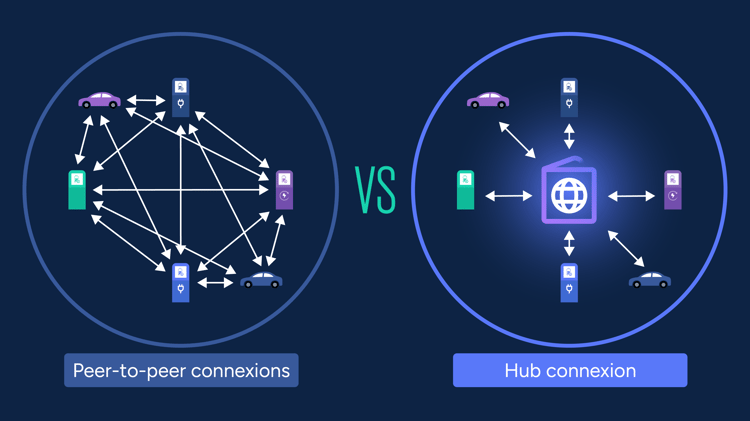
Comparaison connexions

For electric vehicle drivers, this foundation brings greater consistency across charging points and a more standardized experience. “Connecting the various CPOs and eMSPs removes significant barriers that hinder the electric vehicle driver's charging experience,” adds Olivier Proulx. “Drivers no longer need to download multiple apps to start a charging session, since more networks are accessible through each of them. This helps create a simpler, more seamless charging journey.”

This standardized foundation offers advantages beyond those for EV drivers: it also provides strategic value for industry players. While companies would otherwise have to manage each connection individually, connecting to Passport Hub simplifies processes across all operational stages: a single standardized commercial agreement, a single technical integration, and financial reconciliation between the various partners. This results in substantial savings in both time and operational resources. 

“Each company gains access to an extensive partner network through a single connection, which significantly reduces integration time, facilitates standardization, and accelerates the market launch of new charging offers,” adds Olivier Proulx. This not only reduces initial implementation complexity but also provides an exceptional opportunity for market growth.


EV Roaming as a Driver of Innovation

In public charging, connecting stakeholders brings more than operational benefits to the table: it is the key to enabling innovation and accelerating its adoption. This is where the communication standards underlying a roaming hub come into play, ensuring consistent and reliable data exchange between all players in the ecosystem.

The Role of Standards Such as OCPI in Facilitating EV Roaming

In theory, data exchange standards are central to creating a dependable, interconnected environment. They provide a foundation for real-time communication between systems, but in practice, formats and interpretations can vary. “With Passport Hub, we handle these differences by translating between versions of OCPI, for example, from 2.1.1 to 2.2.1, or even between proprietary APIs,” explains Olivier Proulx. “Even when partners use the same protocol, variations or extensions often require adjustments. By managing these translations within the Hub, we ensure compatibility without forcing partners to modify their own code for each new connection. This way, every partner only integrates once and gains access to the entire network.”

The same principle applies to Plug and Charge technology, defined by the ISO 15118 standard. This standard enables a secure and effortless way to activate charging for electric vehicle drivers, but, just like with OCPI, technical feasibility is only part of the equation. While this activation method is already technically possible, as ChargeHub demonstrated with its partners at the CharIN Testival, its adoption remains limited. “Too often, companies overlook EV roaming in their Plug and Charge integration projects,” says Olivier Proulx. “It's a common mistake, but one that can undermine a project's feasibility: without this roaming layer as a foundation, the effort required for deployment multiplies, while the overall reach remains limited.”

EV Roaming: The Key to Large-Scale Plug and Charge

Plug and Charge is a clear example that illustrates the critical role of a roaming hub within the public charging strategy. This technology relies on secure vehicle authentication at the charging station, requiring no further action from the driver.

Plug & Charge Authorization

This authentication is based on certificates that act like digital passports.  Once authentication is done, there is still an authorization step that is needed.  Without a connection to the roaming hub, authorization can only be performed for known certificates, drastically reducing coverage and scalability. “What should be a simple and seamless experience quickly turns frustrating in the absence of compatibility,” says Olivier Proulx. “Connecting to a roaming hub provides access to all certificates held by mobility providers, enabling secure authorization at scale without complicating the technical processes.” 

Centralizing data exchange and authorization reduces friction and accelerates the adoption of cardless and app-free charging methods.“The goal is to remove barriers for all technologies that bridge the gap between the simplicity of stopping at a gas station and that of stopping at a charging station,” explains Olivier Proulx. “That's why we developed a turnkey Plug and Charge integration with our partner Irdeto.”

Building Today the Foundation for Tomorrow's EV Charging

The shift to large-scale e-mobility requires an interconnected infrastructure that facilitates the deployment of the latest technologies. Decisions made today regarding standards, integrations, and partnerships will significantly impact the success of our industry. EV roaming creates an ideal and necessary foundation for a more seamless experience for all electric vehicle drivers. 

With Passport Hub, the largest charging roaming hub in North America, ChargeHub provides you with a solid, proven, and scalable foundation to make every charge as simple as visiting a gas station.