Published on September 20, 2025 (Updated on March 27, 2026)

North America's public charging infrastructure reached a new milestone in the second quarter of 2025. According to ChargeHub's proprietary data, April set a continental record with 64% of reported sessions completed successfully without any friction, the best result in 30 months of continuous monitoring. Yet despite this exceptional performance, one in four drivers who pull up to a public charger still leaves without charging. That tension between progress and persistent challenges defines the story of Q2 2025. Despite this exceptional performance, 25% of reported attempts still fail, highlighting the industry's persistent challenges.

This edition of the Charging Experience Barometer analyzes trends from April to June 2025, with comparisons to Q1 2025 and historical data going back to 2023.


Executive Summary

The second quarter of 2025 confirms that North America's public charging infrastructure is stabilizing at a performance level established over several quarters. While April made headlines with a record 64% success rate, the quarter as a whole tells a more nuanced story of continuity rather than breakthrough.

Q2 2025 Overall Performance: Stability Above 60%

The second quarter of 2025 confirms the consolidation of North American performance around a new threshold. On average for the period, 62% of reported charging sessions proceeded without any issues from start to finish, a level comparable to summer 2024.

The charging failure rate decreased compared to Q1 2025, dropping from 27% to 25%. The second quarter is in the lower range of the historical interval observed over the past two years (24% to 27%). However, this still means that one in four drivers who arriving at a public charger leaves without charging.

Public Charging Success Rates Across Canada and USA, Q2 2025

Public Charging Success Rates Across Canada and USA Q1 2025

3 mo AVG

Minimum Monthly Value

Maximum Monthly Value

Charged successfully without any issues

62%

61%

64%

Charged successfully, but at reduced power or with limited port availability

10%

9%

12%

Charged was initiated, but was difficult or ended prematurely

3%

3%

3%

Charging attempt was unsuccessful

25%

23%

26%


Canada and U.S.: A Gap That's Closing

The dynamic between the two North American markets continued to shift in Q2. Both countries still display distinct profiles, but the gap narrowed on several key indicators. Canada maintained its lead on failure rates, 22.3% vs. 26.7% in the U.S., a 4.4-point gap that has held steady for two years, suggesting structural rather than seasonal differences between the two markets.

What changed is the optimal success rate gap: it shrank from approximately 4 points in Q1 to just 1 point in Q2. This convergence is worth watching closely in Q3, as it reflects opposite trajectories, the U.S. improving while Canada experienced an unusual spring dip (more on this below).
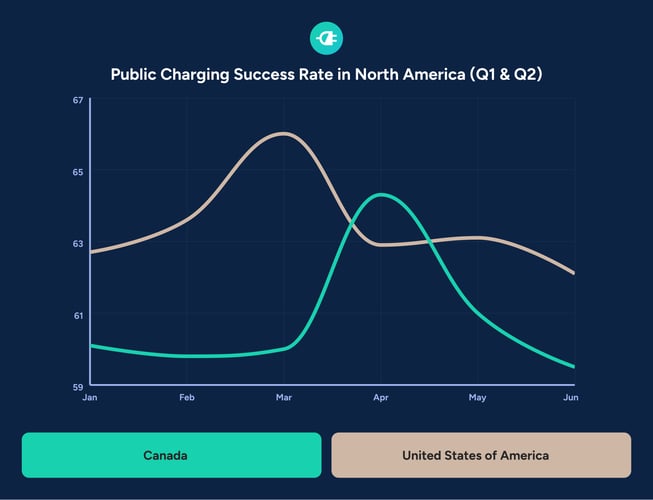
 

CAN vs USA Q1+Q2

Technical Reliability and Availability: Quarter Constants

Two metrics reveal trends worth examining in the overall performance analysis. On one hand, charging sessions that were initiated but difficult or interrupted remain at 3%. On the other hand, sessions that were successful but with reduced power or limited port availability increased from 8% in Q1 to 10% in Q2. This evolution suggests that while equipment functions better once connected, infrastructure must manage more capacity constraints.

Summer 2025 Outlook: Stability Test for Q3

The third quarter will test the infrastructure's ability to maintain these performance levels against increased summer demand. Q3 2024 had established a similar success rate (61.9% of sessions without issues), suggesting the sector should navigate summer 2025 without major surprises, barring exceptional events. The simultaneous reduction in failures observed in Q2 in both countries represents a positive development, notes Simon Ouellette, CEO of ChargeHub, but he tempers: 

“One quarter doesn't make a trend. Q3 data will help confirm whether this improvement holds”

Detailed analysis follows below, including the complete methodology, results by country (United States and Canada), direct comparisons, and an outlook for the third quarter of 2025.

To automatically receive the Q3 2025 report and our upcoming quarterly analyses, subscribe to our professional newsletter .
Introduction

While public charging infrastructure continues to expand in both the United States and Canada, it remains a significant obstacle for potential EV buyers, hindering the adoption of electric vehicles.

A June 2025 J.D. Power study confirms that the top concern among prospective EV owners is still the availability of public charging stations. Among the 41% of respondents who expressed hesitation about purchasing an EV, more than half cited the lack of accessible chargers as a key reason for their decision. This concern has remained consistent since 2024, while other factors, such as vehicle cost, have become less critical.

These findings reinforce the need for tools that can accurately evaluate and monitor the reliability of the charging infrastructure. ChargeHub created the Charging Experience Barometer to meet this need, offering a clear snapshot of what EV drivers experience on the road.

DETAILED ANALYSIS

The following sections present all Q2 2025 data, with in-depth analyses by country and by experience category. This quarterly edition uses the same methodology as previous reports, enabling rigorous comparisons over time.

Methodology

This analysis is based on ChargeHub's proprietary data collected between April and June 2025 across the entire North American public network.

Geographic and technical coverage: United States (50 states) and Canada (all provinces and territories), all charger types (DC Fast Charging and Level 2), and operators compatible with the ChargeHub app.

Four experience categories measured:

  1. Charged successfully without any issues: perfect session from start to finish
  2. Charged successfully, but at reduced power or with limited port availability: success despite constraints
  3. Charging was initiated, but was difficult or ended prematurely: session launched, then problematic
  4.  Charging attempt was unsuccessful: completely unsuccessful attempt

North American Performance: April Record and Quarterly Improvement

Q2 2025 achieves the best quarterly success rate ever recorded, at 62% , matching summer 2024. April marks a historic milestone: 64% of sessions were completed without issues, surpassing the previous 30months since January 2023.

Month

Charged without issues

Reduced power/port

Difficult/interrupted

Failure

April

64%

11%

3%

23%

May

62%

9%

3%

26%

June

61%

12%

3%

25%

Q2 Average

62%

10%

3%

25%

Q1 Average

61%

8%

3%

27%


Comparison with First Quarter

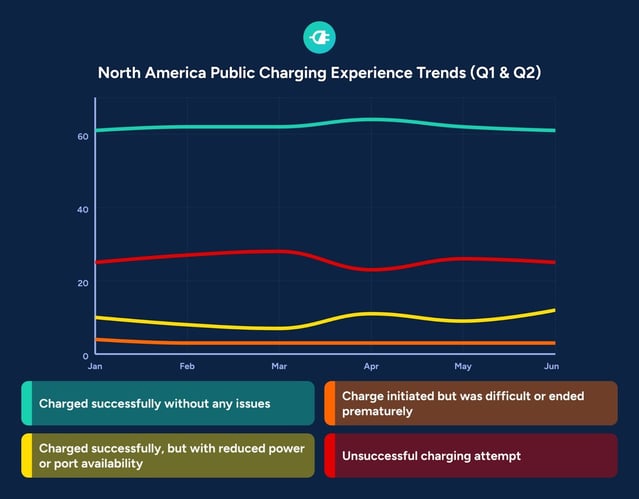
The improvement between Q1 and Q2 follows expected seasonal trends, with a progression in optimal success rate and a reduction in failures, consistent with winter-to-spring transitions observed in previous years.

Evolution by indicator:

  • Charged successfully without any issues : Expected progression due to milder spring conditions
  • Charging attempt was unsuccessful (from 27% to 25%): Returns rate to the low end of the historical range (24-27%)
  • Charged was initiated, but was difficult or ended prematurely (3%): Maintains the level of excellence achieved
  • Charged successfully, but at reduced power or with limited port availability : Increase consistent with historically observed spring demand surge

United States: 5-Point Range Between April and June

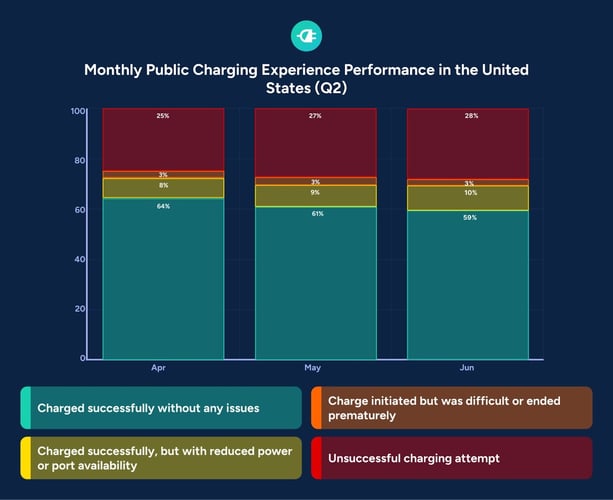
The U.S. market shows an average success rate of 61.6%, with a 5-point range from April (64%) to June (59%), illustrating limited capacity to sustain peak performance over time.

Month

Charged without issues

Reduced power/port

Difficult/interrupted

Failure

April

64%

8%

3%

25%

May

61%

9%

3%

27%

June

59%

10%

3%

28%

Q2 Average

61,6%

8,9%

2,9%

26,7%

Q1 Average

60%

8%

4%

28%


Distinctive Features of the U.S. Market

Contrasting performance:

  • April record (64%): Matches best continental result, coinciding with favourable spring weather conditions
  • Normalization in June (59%): Return to the historical average with increased pre-summer demand

Better availability management:

  • 8,9% of sessions with reduced availability or power, 3.3 points better than Canada
  • Places the U.S. in the lead on this specific indicator

Failure challenge:

  • 26.7% failures, 4.4 points higher than Canada
  • March 2025 had reached 32%, the worst result in two years
  • Q2 returns the rate to the usual range observed over two years (24-27%)

Q1-Q2 improvement:

  • 1.6-point gain in optimal success and 1.3-point reduction in failures
  • Improvement slightly exceeds the seasonal progression of 2023-2024

Canada: Stability and Lower Failure Rates

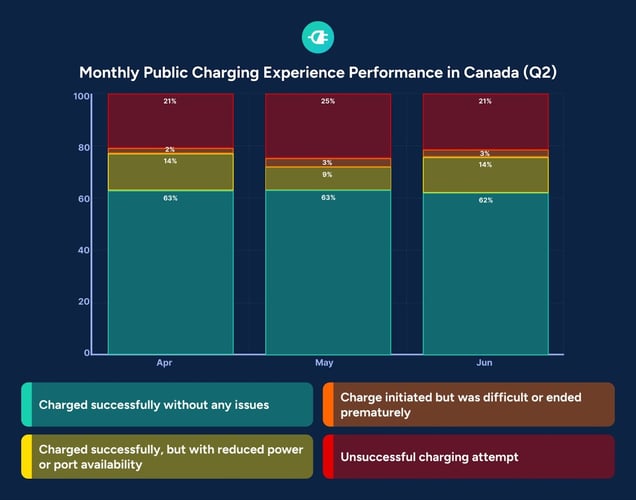
The Canadian market maintained an average success rate of 62.7%, ranging from 62% to 63% during the quarter. This relative stability contrasts with the U.S. amplitude. 

Month

Charged without issues

Reduced power/port

Difficult/interrupted

Failure

April

63%

14%

2%

21%

May

63%

9%

3%

25%

June

62%

14%

3%

21%

Q2 Average

62,7%

12,2%

2,8%

22,3%

Q1 Average

64%

8%

3%

23%


Identified Strengths and Weaknesses

Better-than-average performance for failed, difficult, or interrupted sessions:

  • 22.3% failures compared to 26.7% in the United States (4.4 percentage point gap)
  • Absolute record at 2% in April (charging initiated category, but difficult or interrupted)
  • Among the best results observed since measurements began

Significant variation in availability:

  • 12.2% of sessions were successful but with reduced power or limited port availability (vs. 9% in the U.S.)
  • 5-point swing: 14% in April, 9% in May, 14% in June
  • Largest variation among the four measured categories

Unusual seasonal reversal:

  • Historically, Canadian Q1 shows lower performance than Q2 due to winter conditions
  • The 2025 reversal (Q1 better than Q2) represents a new phenomenon

USA–Canada Comparison

Indicator

Q2 Canada

Q2 USA

Charged successfully without any issues

62,7%

61,6%

Charged successfully, but at reduced power or with limited port availability

12,2%

8,9%

Charged was initiated, but was difficult or ended prematurely

2,8%

2,9%

Charging attempt was unsuccessful

22,3%

26,7%


Opposing Dynamics

Convergence on optimal success:

  • USA: improvement between quarters (60% → 61.6%)
  • Canada: decline between quarters (64% → 62.7%)
  • Gap reduced to 1.1 points between the two countries in Q2

Reversal on availability:

  • Canada: deterioration of 4.2 points (8% → 12.2% of sessions with reduced availability or power)
  • USA: moderate increase (8% → 8.9%)
  • The United States now shows better performance (8.9% vs 12.2%)

Stability on failures:

  • Canadian advantage of 4.4 points persists regardless of seasonal variations
  • Consistent observation for two years

Q3 2025 Outlook

The third quarter of 2024 reached an average success rate of 61.9%. Q3 2025 will benefit from similar favourable weather conditions but must contend with increased summer demand.

Key indicators to monitor:

  • Canada: Stabilization of the swing in reduced availability (5-point variation observed in Q2)
  • United States: Maintaining progress against increased summer traffic
  • Continental: Confirmation of positioning in the low end of the historical range for failures (24-25%) 


ChargeHub Solutions for Operators and Businesses

ChargeHub supports charging network operators and fleet managers in optimizing their infrastructure and improving the driver experience.

Receive the Q3 2025 report: Subscribe to our professional newsletter to receive upcoming quarterly editions and exclusive industry analyses.