How to Charge Your EV From a 120V Outlet While Travelling

Published on November 03, 2026 (Updated on November 03, 2026)

Key Takeaways

  • Your EV can plug in almost anywhere. Every EV sold in North America can charge from a standard 120V wall outlet using the Level 1 cord included with most models.
  • It’s slow, but it works. Expect 5 to 8 km (3 to 5 miles) of range per hour, or 40 to 65 km (25 to 40 miles) after an 8-hour night.
  • Not all outlets are created equal. At a hotel, cottage or campground, check the circuit and the property’s rules before plugging in.
  • For long trips, rely on public charging stations. Plan your stops around Level 2 and DC fast charging stations. The ChargeHub app shows them all in Canada and the US.

Your first big EV road trip is coming up, but one question keeps nagging you. Can you charge your EV from a 120V outlet while travelling, even far from any public charging station? The short answer is yes. Most EVs sold in North America come with a portable charging cord that plugs into a standard wall outlet — the same one that powers your toaster.

On the road, it's a bit more complicated than at home. You don’t know the condition of the outlet, the circuit it’s connected to, or the property’s rules. Here’s what this guide covers:

  • How charging from a standard 120V outlet works

  • What 120V charging delivers in real numbers, model by model

  • Hotel, cottage, campground: what to check before plugging in

  • Safety precautions to always follow

  • When to rely on Level 2 charging stations instead of 120V

  • How to plan your charging stops with ChargeHub


How Charging From a Standard 120V Outlet Works

Plugging your EV into a standard outlet is called Level 1 charging. It's simple. All you need are three things:

  • A standard wall outlet — the three-prong kind you find everywhere (technically known as a NEMA 5-15).
  • The portable EVSE cord, which connects the outlet to the car.
  • The connector, at the end of the cord, plugs into the car’s charging port. Most models use the J1772 connector, while Teslas (and several recent models) use the NACS connector.

Good news for travellers: Canada and the US use exactly the same electrical outlets. A Canadian driver can plug their cord into an outlet in Maine or Florida without an adapter. For a detailed comparison of the three charging levels, see our home EV charging guide.

The Portable EVSE Cord: The Accessory to Always Keep in Your Trunk
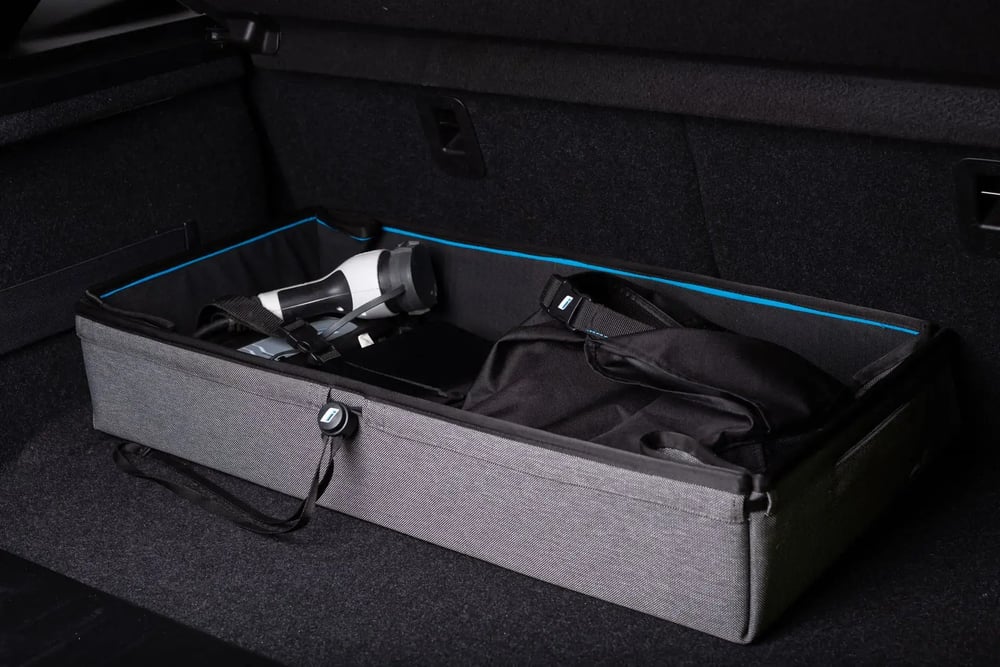
Portable EV charging cord stored in a trunk organizer in the back of an electric vehicle

Without this cord, you can't charge from a 120V outlet. Often called a “portable charger” or “mobile connector,” it’s a cable with a small control box that automatically cuts power if it detects a problem. That’s what makes charging from a standard outlet safe.

The cord is light and stores easily in the trunk or under the cargo floor. Make packing it a habit, just like your phone charger. Many owners leave it connected in the garage all year and only notice it's missing when they need it. Some automakers, including Tesla, now sell it separately. Make sure it’s in your vehicle before you hit the road.

What 120V Charging Really Delivers, by the Numbers

On a standard outlet, charging is very slow, at least five times slower than at a public Level 2 charging station. The US Department of Transportation estimates that Level 1 charging adds roughly 3 to 8 km (2 to 5 miles) of range per hour.

Most recent EVs fall in the upper half of that range, between 5 and 8 km (3 and 5 miles) per hour. Several factors can lower that figure, such as cold weather, battery heating or a less efficient model. When planning a leg, think in kilometres rather than kilowatts — that’s what matters when it’s time to get back on the road.

Range Added by Model After a Night of Charging

ModelRange/hour (approx.)After 8 h of charging
Hyundai IONIQ 6 7 to 8 km (4 to 5 mi) 55 to 65 km (34 to 40 mi)
Chevrolet Equinox EV 5 to 6 km (3 to 4 mi) 40 to 50 km (25 to 31 mi)
Nissan Leaf (40 kWh) 6 to 7 km (about 4 mi) 45 to 55 km (28 to 34 mi)
Tesla Model Y Up to 5 km (3 mi) Up to 40 km (25 mi)
Ford Mustang Mach-E 5 to 6 km (3 to 4 mi) 40 to 50 km (25 to 31 mi)
Estimated values for a cord set to 12 A in mild weather. Sources: Tesla (Mobile Connector, NEMA 5-15 adapter), US Department of Transportation (Charger Types and Speeds).

In practice, a night at a hotel plugged into a 120V outlet covers a short leg or a few local trips. It's no substitute for a proper charge after a full day on the highway.

Hotel, Cottage, Campground: Not All 120V Outlets Are Created Equal

At home, you know your electrical panel. Elsewhere, outlets that look identical can be wired very differently. Three situations come up often when travelling.

Charging at a Hotel

Room outlets are rarely reachable from the parking lot. They also often share a circuit with the lights, TV or air conditioner, and they aren’t designed to deliver power nonstop all night.

Plan ahead when you book. Ask whether the hotel offers an outdoor outlet reserved for EVs or, better yet, a Level 2 charging station in its parking lot. The ChargeHub map also helps you spot charging stations on site or within a few minutes’ walk of where you’re staying.

Charging at a Cottage or Staying With Family and Friends

At the cottage or at a friend’s or relative’s place, the 120V outlet often becomes your main charging source. Charging stations can be scarce, and you’re staying several days. The good news: over two or three nights plugged in, you can add anywhere from 80 to nearly 200 km (50 to 125 miles) of range. A few precautions are all it takes:

  • Before you leave: ask your hosts (or the owner, for a rental) which outlet to use.
  • Once you’re there: avoid running other large appliances on the same outlet.
  • To top up: use ChargeHub to find a Level 2 charging station in town or along the way. A quick top-up while you grocery shop or grab a bite makes up for what the 120V outlet can't deliver overnight.

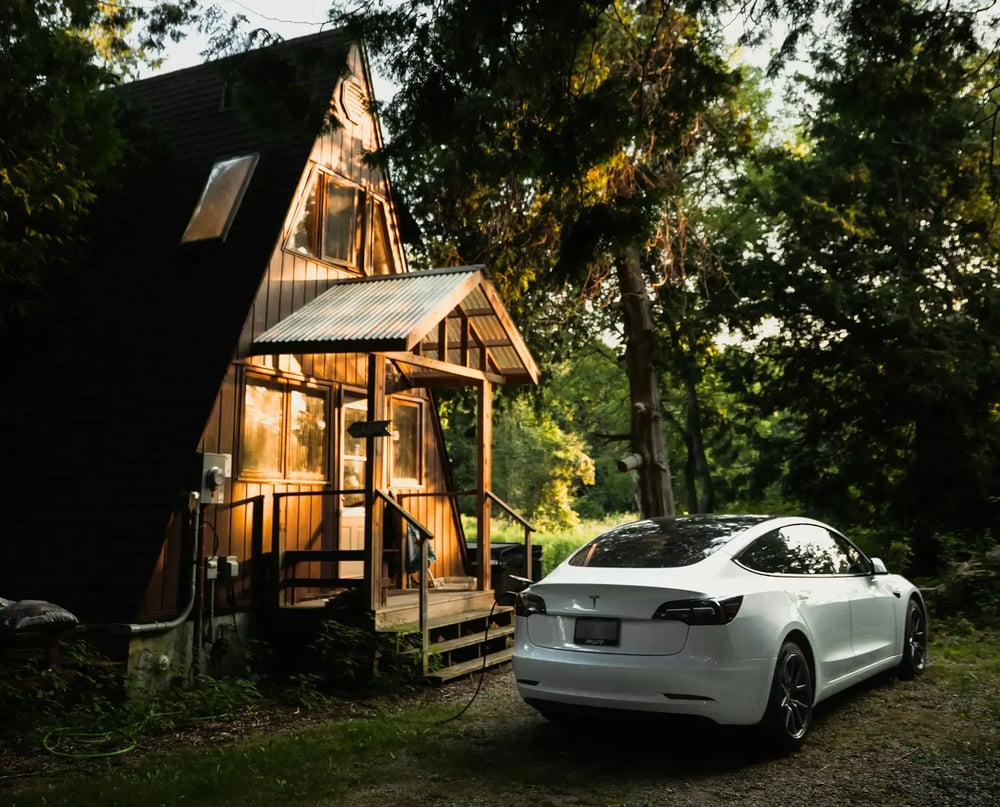
White electric car parked in front of an A-frame cottage in the woods, a typical spot to charge on a 120V outlet

Charging at a Campground

Before plugging your EV in at a campground, check the rules: many campgrounds have their own. Some prohibit EV charging on standard site outlets because multiple vehicles plugged in at once can overload the electrical system. Others allow it, sometimes for a fee.

RV sites can be a better option. Some offer a heavy-duty 240V outlet (NEMA 14-50) that charges much faster, provided you have the right cord or adapter. Other RV outlets (TT-30) charge no faster than a standard outlet.

Before booking, ask about the campground’s policy. A quick phone call can save you a lot of hassle.

SettingAvailable outletMain riskPractical tip
Hotel (room) NEMA 5-15 Non-dedicated circuit Ask for an outdoor outlet or a Level 2 charging station
Cottage/family and friends NEMA 5-15 Shared circuit Check the breaker and limit other appliances
Campground, RV hookups TT-30 (120V) or NEMA 14-50 (240V) Campground policy Confirm EV charging is allowed. Only the 14-50 speeds up charging.
Campground, standard outlet NEMA 5-15 Overload or prohibition Choose a site with Level 2 charging stations

Safety Precautions to Always Follow When Charging From a 120V Outlet

Level 1 charging puts a steady load on the outlet for hours. These few rules eliminate most of the risk:

  • Plug the cord directly into a wall outlet — never into an extension cord or power bar.
  • Only use a three-prong outlet.
  • Only use the cord supplied or recommended by your vehicle’s manufacturer.
  • After about 30 minutes, touch the connector, the cord and the outlet. If anything feels unusually hot, unplug right away.
  • Avoid worn, loose or scorched outlets.

⚠ Warning

Never plug your EV into an extension cord, even a short one. Charging for several hours can overheat the extension cord and cause a fire.

Long-Distance Travel: When 120V Isn’t Enough

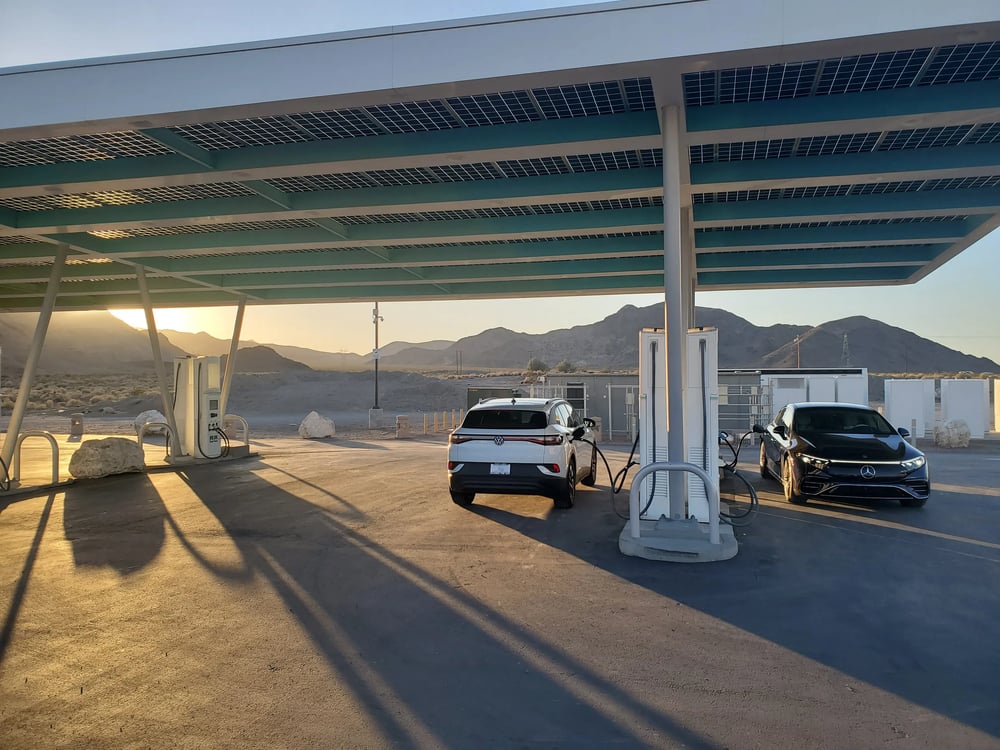
Two electric vehicles charging under a solar canopy at a DC fast charging station along a highway, with mountains in the background

For a 300 to 400 km (185 to 250 miles) day, 120V isn’t enough. A full night adds 40 to 65 km (25 to 40 miles), while a nearly empty battery needs several hundred kilometres.

Think of Level 1 as a safety net. It supplements your daytime charging rather than replacing it. Plan long legs around Level 2 and DC fast-charging stations along major highways. Our EV road trip planning guide walks you through it.

Level 1, Level 2 or DC Fast Charging: The Right Tool for Each Leg

Each charging type has its place in an itinerary. The choice mostly depends on how much time you have at each stop.

Charging typeSpeedBest forWhere to find it on the road
Level 1 (120V) About 5 to 8 km (3 to 5 mi) of range per hour A full night where you’re staying Anywhere there’s a standard outlet
Level 2 (240V) About 15 to 30 km (9 to 19 mi) per hour, more with a higher-powered station and vehicle A 1- to 3-hour daytime stop Hotels, shopping centres, public parking lots
DC fast charging 80% battery in 20 min to 1 h A quick stop on the road Major highways, dedicated charging hubs
Source: US Department of Transportation (Charger Types and Speeds).

How to Plan Your Charging Stops With ChargeHub

The best way to avoid relying on a hotel outlet is to know ahead of time where you’ll charge. ChargeHub brings stations from every network together on a single map, so you don’t have to juggle apps on the road. Here’s what the app lets you do across Canada and the US:

  • Browse the interactive map in the app or online.
  • Filter charging stations by connector type (J1772, NACS) and charging speed.
  • Pay for charging directly in the app at 160,000+ charging ports in Canada and the US.
  • Plan your route with the app’s built-in trip planner.

FAQ: Charging From a 120V Outlet While Travelling

Can I plug my EV into any 120V outlet while travelling?

Yes, most vehicles include a Level 1 cord. The outlet must be a three-prong outlet and, ideally, shouldn’t be powering any other device at the same time.

Is charging from a 120V outlet dangerous?

No, as long as you follow a few basic rules: no extension cords, an outlet in good condition, and only the manufacturer’s cord. Level 1 charging is designed to run for many hours.

How much range do I get from one night plugged into a 120V outlet?

Between 40 and 65 km (25 and 40 miles) after 8 hours, depending on the model and temperature. That’s enough for a short leg the next day, but not for a long day of driving.

Are 120V outlets the same in Canada and the US?

Yes. Both countries use the same standard: NEMA 5-15 at 120V and 60 Hz. A Canadian driver can plug their Level 1 cord into any standard US outlet without an adapter.

Can I charge my EV at a campground with a 120V outlet?

Sometimes, but it’s not guaranteed. Some campgrounds prohibit EV charging on standard outlets to avoid overloading them. Check the campground’s policy before booking, and choose a site with Level 2 charging stations or NEMA 14-50 outlets.