Montréal, Québec EV Charging Stations Info
General EV Charging Information
Montréal stands apart from every other Canadian city for EV drivers: it sits at the heart of a province that accounts for 39% of all EV charging infrastructure nationwide, according to the McGill University Health Centre. EV charging in Montréal benefits from Hydro-Québec's clean, affordable hydroelectric electricity -- among the lowest-cost power in North America -- and a dense public charging network anchored by the Electric Circuit, FLO, and ChargePoint. EV charging in Montréal is not a question of whether stations exist; it is a question of knowing which networks to use, where to find DC fast charging when you need it quickly, and how to navigate the city's high-density apartment landscape. This resource covers all of it.
Montréal's Public Charging Network: Electric Circuit, FLO, and ChargePoint
EV charging in Montréal runs on three dominant networks, each with a distinct footprint across the island.
The Electric Circuit, operated by Hydro-Québec, is the province's main public charging network for electric vehicles, with an extensive presence of public charging stations including fast-charge stations in every region of the province. In Montréal, Electric Circuit charging stations appear in municipal parking lots, metro-adjacent facilities, shopping centers, and street-level parking throughout the downtown core and inner boroughs.
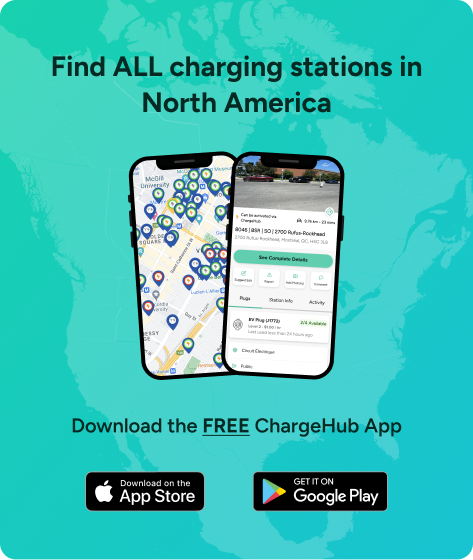
FLO is headquartered in Quebec and has an extensive presence across the province. FLO stations are common at commercial properties, grocery stores, and workplace parking across the island. Electric Circuit members also have access to ChargePoint charging stations and the FLO network, meaning a single account can unlock charging across multiple networks -- a key advantage for drivers who want to locate stations without juggling separate apps. All three networks are accessible through the ChargeHub app, which consolidates real-time availability and payment across every major charging network in one place.
Connector compatibility at a glance:
| Connector Type | What It Means | Where Found in Montréal |
|---|---|---|
| J1772 | J1772 (standard North American AC charging connector) | All Level 2 public stations |
| CCS | CCS (Combined Charging System, standard DC fast-charging connector) | DC fast charging hubs, highway corridors |
| CHAdeMO | CHAdeMO (Japanese DC fast charging standard) | Select Electric Circuit fast chargers |
| NACS | NACS (North American Charging Standard, Tesla connector now industry-wide) | Tesla Superchargers; growing at new stations |
Before your first session, confirm your vehicle's connector type using the ChargeHub interactive map to filter by compatible charging ports.
Charging Patterns Across Montréal's Boroughs
EV charging in Montréal is not evenly distributed across the island. Understanding where stations concentrate helps drivers plan more effectively.
Research published in the Journal of Urban Mobility (2026) identified "double-burden" neighborhoods where higher concentrations of older residents overlap with poor access to EV charging. These areas are more common outside the city's dense, amenity-rich core, where charging infrastructure is currently concentrated.
Here is how coverage breaks down by area type:
- Downtown / Ville-Marie: A high density of EV charging stations. Level 2 charging (240V, adds 11-54 miles/hour) is available at underground parking garages, office towers, and street-level lots along Rue Sainte-Catherine and near the Bell Centre.
- Plateau-Mont-Royal: A mix of Electric Circuit and FLO stations near commercial strips and parks. Parking is competitive, so checking real-time availability before arriving saves time.
- Mile-End and Rosemont: Growing coverage at grocery anchors and community parking. Certain stations offer free or low-cost charging at shopping centers.
- Griffintown and Sud-Ouest: Newer development has brought ChargePoint and FLO stations to residential and mixed-use buildings, reflecting the area's recent construction boom.
- East End (Mercier--Hochelaga-Maisonneuve, Rivière-des-Prairies): Coverage is thinner than the core. Drivers in these boroughs benefit most from planning routes in advance using the ChargeHub map.
EV charging in Montréal rewards drivers who check availability before leaving. Real-time availability data on the ChargeHub platform reflects current station status across all networks simultaneously.
Destination Charging: Montréal-Trudeau Airport, Hotels, and Attractions
Trip planning around EV charging in Montréal is straightforward at major destinations, though policies and fees vary by property.
Montréal-Trudeau International Airport (YUL)
In the HotelParc short-term parking lot, Electric Circuit charging stations are available for self-service use. At parking P4, Electric Circuit charging stations are available on level 2 for self-service use. Drivers using the valet service need an Electric Circuit card. Confirm current parking fees with the airport directly before your trip.
Downtown Hotels with EV Charging
Destination charging is well-established at Montréal's major downtown hotels. Properties with confirmed EV charging include:
- Le Westin Montréal: Le Westin Montréal offers electric vehicle charging stations for guests, with free charging available, though parking fees apply.
- Hotel Bonaventure Montréal: Charging stations available in the underground parking lot, open and guarded 24 hours.
- Hotel Monville: Hotel Monville offers an electric vehicle charging station for guests using their valet parking service, with an additional charge for the charging service providing 24 hours of charging.
- AC Hotel by Marriott Old Montréal: AC Hotel by Marriott Old Montréal has electric vehicle charging stations available, with parking subject to availability and a fee applying for the charging station.
Always confirm EV charging availability when booking, as station access policies differ between properties.
Attractions and Shopping Centers in Montréal
The Quartier des Spectacles, Old Port, and Olympic Park areas all have public charging stations nearby. Certain shopping centers and malls in Montréal offer free Level 2 charging as a customer amenity -- a practical way to top up during a visit to the Plateau or Rosemont commercial strips. Use the ChargeHub map to locate free charging options near your destination before you go.
Charging Access for Montréal Apartment and Condo Residents
EV charging in Montréal presents a real challenge for the city's large renter and condo-owner population. Montréal is a majority-renter city, and condo boards have historically been slow to approve charging installations. Two major programs now address this directly.
Quebec's Écorecharge Program (Effective March 17, 2026)
Écorecharge is a Quebec government financial assistance program designed to accelerate the installation of electric vehicle charging in multifamily residential buildings. Unlike programs that offer a single rebate, Écorecharge supports three distinct phases of a charging project -- from initial planning through electrical upgrades to charger installation -- each with its own dedicated funding stream.
Key funding tiers for property owners and condo syndicates:
- Feasibility analysis: Up to $5,000 -- the program covers 75% of eligible professional service fees for a consultant to assess your building's electrical capacity and evaluate charging solutions.
- Electrical infrastructure upgrades: Up to $120,000 -- this is a major incentive and covers the make-ready work needed to prepare your building's electrical system for chargers, with the program covering 50% of eligible expenses.
- Charging station installation: A flat-rate incentive of $600 per installed charging station (or per charging port, for multi-port units).
New Quebec Construction Code Requirements
Quebec's updated Construction Code introduces new obligations for residential buildings with five units or more, which will now be required to include basic electrical infrastructure allowing for the future installation of Level 2 charging equipment for all parking spaces. This applies to new buildings going forward, as confirmed by Propulsion Québec in March 2026.
For individual tenants whose building has not yet upgraded, the Écorecharge program offers up to $5,000 for the purchase and installation of a charging station in a multiple dwelling. Visit Gouvernement du Québec's Écorecharge page for current eligibility details.
Quebec and Federal Incentives for EV Ownership in Montréal
Montréal drivers benefit from a stacked incentive structure combining provincial and federal programs. Timing matters: the provincial Roulez vert program ends December 31, 2026.
Roulez Vert Program (Province of Quebec)
During Budget Speech 2024-2025 on March 12, 2024, the Québec government announced a gradual reduction in the amount of financial assistance granted for the purchase of electric vehicles as of January 1, 2025. The program will end on December 31, 2026.
Current 2026 rebate amounts, per the Gouvernement du Québec's official Roulez vert page:
- New fully electric vehicle: $2,000 (for vehicles registered in 2026)
- New plug-in hybrid (15 kWh or more): $1,000
- New plug-in hybrid (8 to less than 15 kWh): $500
- Used fully electric vehicle: $1,000
- Vehicle MSRP eligibility cap: Under $65,000
To benefit from the $2,000 provincial electric vehicle incentive, your vehicle must be registered before December 31, 2026.
Federal Electric Vehicle Affordability Program (EVAP)
In February 2026, Ottawa launched the Electric Vehicle Affordability Program (EVAP), which offers incentives of up to $5,000 for battery or hydrogen EVs, or up to $2,500 for plug-in hybrids, targeting transactions with a final value not exceeding $50,000.
The federal government indicates that provincial and territorial incentives may be combined with the federal incentive, according to the rules in effect. An individual in Quebec can therefore aim to combine the EVAP and Roulez vert subsidies, if the vehicle is eligible for both and if the transaction rules are followed.
Charging Costs and Network Pricing in Montréal
Hydro-rich Quebec leverages abundant, low-cost hydroelectric assets to offer some of North America's lowest residential power, with baseline energy rates hovering between 7.8¢/kWh and 10.6¢/kWh. Public charging rates are higher, but still among the most competitive in Canada.
Approximate public charging rates in Montréal (rates vary by network, location, and time of use):
| Network | Charger Level | Approximate Rate | Pricing Model |
|---|---|---|---|
| Electric Circuit | Level 2 | Generally around $1.00/hour | Per-minute billing |
| Electric Circuit | Level 3 (DCFC) | Typically $0.30--$0.55/kWh | Per-kWh |
| FLO | Level 2 / DCFC | Rates set by station owner; generally $0.25--$0.50/kWh | Per-kWh |
| ChargePoint | Level 2 / DCFC | Host-set; typically $0.25--$0.50/kWh for L2 | Per-kWh or per-hour |
Electric Circuit partners can adjust their electric car charging rates on June 1 and December 1 each year. Always verify current rates in the ChargeHub app before starting a session, as pricing changes regularly.
Level 3 charging, also called DCFC (DC Fast Charging), uses kilowatts (kW) of power to deliver rapid top-ups. DC fast chargers can add 150--300 km in 20--30 minutes. For EV charging in Montréal on a time-sensitive trip, DCFC stations near the downtown core and along Highway 20 and Highway 40 corridors provide the fastest turnaround.
Free charging remains available at certain shopping centers and dealerships across the island. Use the ChargeHub map's filter options to locate free stations near your route.
Practical Tips for EV Charging in Montréal
- Use ChargeHub to check availability before you leave: The ChargeHub app shows real-time availability across Electric Circuit, FLO, ChargePoint, and all other major networks in one place. No separate accounts needed to locate or pay for charging.
- Download the app for your device before your trip: Get the iPhone app or the Android app and set up your payment method in advance -- not in a parking garage.
- Charge to 80% at DCFC stations: The price to charge a vehicle above a 90% charge level doubles if the power supplied is less than 50 kW. This helps free up charging stations more quickly for other users. Stopping at 80% is faster and cheaper.
- Avoid peak parking hours downtown: Charging stations in Ville-Marie and the Plateau are busiest on weekday evenings and weekend afternoons. Plan sessions during off-peak windows when possible.
- Confirm connector type before driving to a station: Montréal's public network includes J1772, CCS, CHAdeMO, and NACS connectors. The ChargeHub map filters by connector type so you only see compatible stations.
- Check hotel charging policies when booking: Certain downtown hotels offer free EV charging but charge for parking. Confirm both costs when reserving to avoid surprises.
- Take advantage of free charging at shopping centers: Certain malls and grocery anchors across Montréal offer complimentary Level 2 charging. These sessions are ideal for topping up during errands rather than paying for a dedicated charging stop.
- Act on Roulez vert before December 31, 2026: Quebec's provincial EV purchase rebate ends at year-end. Combine it with the federal EVAP program for maximum savings on a new EV purchase.
Frequently Asked Questions
Where can I find DC fast charging in Montréal?
EV charging in Montréal includes an extensive network of DCFC (DC Fast Charging) stations operated primarily by the Electric Circuit and FLO. Fast charging hubs are concentrated downtown, near major highway interchanges on the 20 and 40 corridors, and at Montréal-Trudeau Airport. Use the ChargeHub map to locate the nearest available DCFC station in real time.
How much does public EV charging cost in Montréal?
Rates vary by network and charger type. Electric Circuit Level 2 stations generally cost around $1.00/hour, while DCFC sessions typically range from approximately $0.30 to $0.55/kWh on the Electric Circuit network. FLO and ChargePoint rates are set by the station host and generally range from $0.25 to $0.50/kWh for Level 2. Rates change on June 1 and December 1 each year on the Electric Circuit network, so always verify current pricing in the ChargeHub app before starting a session.
What incentives are available for EV charging in Montréal in 2026?
Quebec's Roulez vert program currently offers up to $2,000 for a new fully electric vehicle registered before December 31, 2026, with lower amounts for plug-in hybrids and used EVs. The federal EVAP program, launched in February 2026, adds up to $5,000 for eligible battery EVs on vehicles priced under $50,000. Both incentives can be combined if the vehicle qualifies for each. Visit the Gouvernement du Québec's Roulez vert page for the current eligible vehicle list.
I live in a Montréal condo and my board won't approve a charger. What are my options?
Quebec's Écorecharge program, which took effect March 17, 2026, provides up to $5,000 for individual tenants or owners in multi-unit dwellings to purchase and install a personal charging station. Condo syndicates and property managers can access separate funding of up to $120,000 for electrical infrastructure upgrades. Electric vehicle charging in Montréal condos is also supported by the updated Quebec Construction Code, which now requires new residential buildings with five or more units to include basic Level 2 charging infrastructure in parking areas.
Which charging networks work best for electric vehicle charging Montréal visitors?
Visitors will find the Electric Circuit and FLO networks cover the most ground across Montréal EV charging stations. ChargePoint is common at commercial parking and hotels near the downtown core. The ChargeHub app consolidates all three networks -- plus Tesla Superchargers and others -- into a single map with real-time availability, so visitors can locate stations, check connector compatibility, and pay without managing multiple accounts. Download the ChargeHub app before arriving in the city for the smoothest experience.
Charging Stats For Montréal

94%
of Level 2 Stations
2863
total Level 2 Stations

6%
of Level 3 Stations
169
total Level 3 Stations
Percentage of Free Stations: 6%
Total Number of Free Stations: 171
Total Number of Charging Stations: 3032
Main Networks: Circuit Électrique, Flo, ChargePoint